6 Min Read
Laser angioplasty is changing how heart blockages are treated. During the procedure, a thin tube with a laser tip is passed through the artery to clear hardened plaque and restore blood flow. After that, a small balloon or stent is placed to keep the artery open. It’s a minimally invasive heart treatment that is being used these days when the regular angioplasty procedure is not sufficient to break up the tough or complicated blockages. For patients undergoing the procedure, they can expect a shorter hospital stay, faster recovery, and a good long-term prognosis. This article looks at how laser angioplasty works and what patients can expect from it.
Synopsis
Understanding Angioplasty and Its Role in Heart Care
Coronary artery disease (CAD) happens when fat and calcium collect inside the arteries that carry blood to the heart. The blockages become a restriction for blood flow, which can cause chest pain, heaviness, or shortness of breath. If not treated in time, the blocks can lead to a heart attack. The main goal of cardiac revascularisation is to open up these narrowed arteries and allow blood moving freely again.
In traditional angioplasty, a thin tube with a small balloon at its tip is pushed through the artery to where the blockage is located. The balloon is then inflated to widen the space, and a small stent is left in there to keep it open. This type of coronary artery disease intervention works well for most patients. But, in some cases, patients have very hard or stubborn blockages for which the traditional angioplasty may not be enough; laser angioplasty is a big leap here.
How Laser Angioplasty Works
Laser angioplasty uses a method called excimer laser coronary angioplasty (ELCA). In this, instead of the usual thermal laser, a cool UV laser light helps remove plaque from inside the artery. During the procedure, doctors guide a thin tube with the laser tip to the blocked area. The laser outputs quick pulses of ultraviolet light that gently vaporise the plaque, which is blocking the artery. In that way, it is able to open up the artery without scraping or putting pressure on its walls.
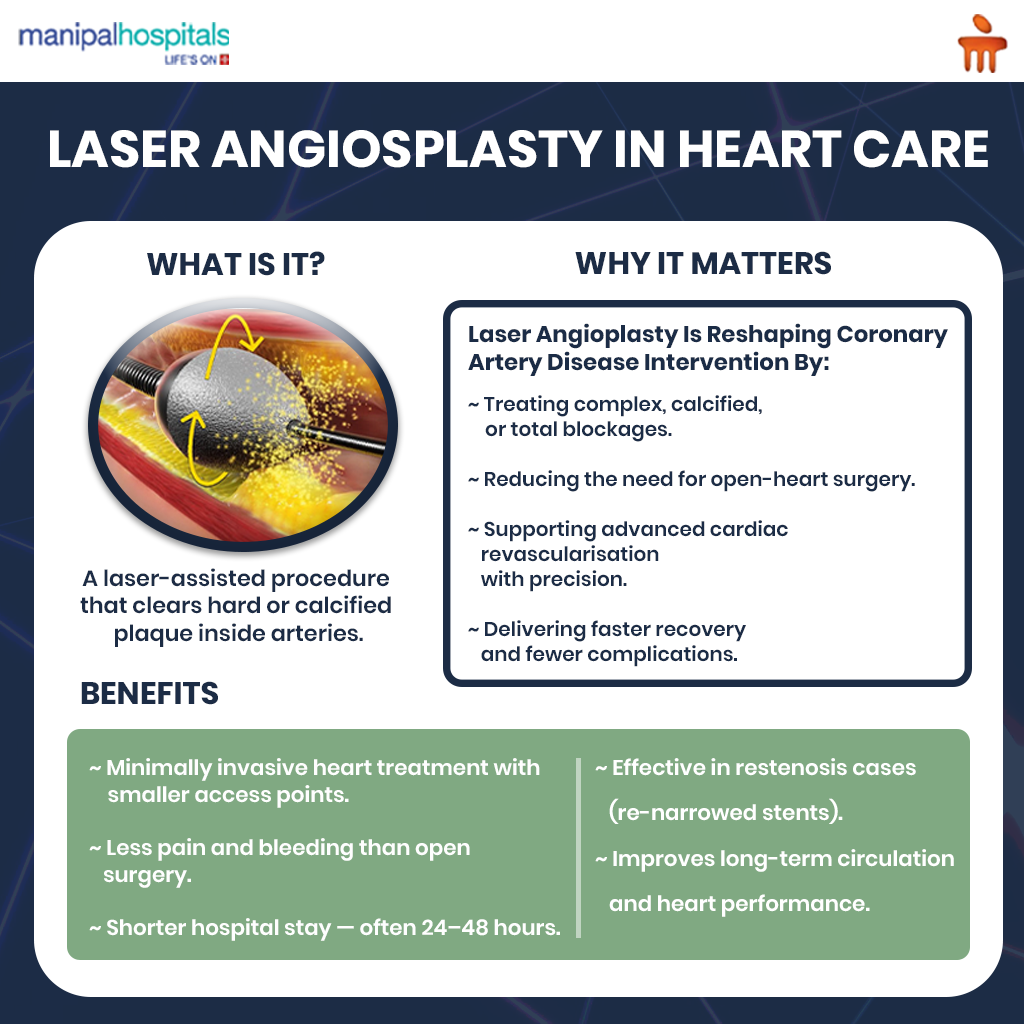
This approach is very useful in treating chronic total occlusions, restenosis, or blockages where a stent can’t be placed easily. Compared to the balloon method, it gives doctors more control, especially for tough or calcified deposits. Being a minimally invasive heart treatment, laser angioplasty helps restore blood flow safely. Hence, it is now becoming an important option for complex heart blockages.
How Laser Angioplasty Is Changing Heart Care
Laser angioplasty has become a big step forward in the way doctors manage blocked arteries. It adds another level of accuracy to modern heart care and helps in cases where regular angioplasty may not be enough. The technique is now seen as an important part of advanced cardiac revascularisation, offering better outcomes for many patients with complex or calcified heart blockages.
Why it’s seen as revolutionary:
-
It can break through hard, calcified, or complicated blockages that are difficult to treat with standard tools.
-
It can sometimes reduce the need for open-heart surgery in high-risk patients.
-
In experienced hands, the procedure is safer and quicker, with fewer complications.
By improving long-term results and reducing the risk of repeat blockages, laser angioplasty is proving to be an effective coronary artery disease intervention. It reflects the shift in cardiology toward minimally invasive heart treatments that are precise and patient-friendly.
What You Can Expect During and After the Procedure
For most patients, laser angioplasty is a straightforward and carefully monitored procedure. It’s done by a team of specialists using advanced imaging to guide every step. Since it’s a minimally invasive heart treatment, there are no large cuts. The recovery is also expected to be much faster.
Before the procedure:
Patients are asked to undergo a few tests, such as blood work, ECG, and imaging scans, to check the location and severity of the blockage.
During the procedure:
-
The area is numbed using local anaesthesia.
-
A thin tube is inserted through the wrist or groin into the artery.
-
The laser catheter is guided to the blocked section under imaging.
-
The laser clears the plaque, and if needed, a stent is placed to keep the artery open.
After the procedure:
Patients are kept under observation in the cardiac unit for some time. Most can go home within a day or two. Mild soreness or tiredness may occur, but it settles soon. Doctors usually recommend light activity, a balanced heart-friendly diet, and regular medicines to support full recovery.
Conclusion
Laser angioplasty has made it possible for many heart patients to get treated safely without the need for major surgery. It helps restore normal blood flow and lowers the chances of future heart complications. With proper follow-up, medicines, and lifestyle changes, most patients go back to their regular routines in a short time.
If you or a loved one has been advised of an angioplasty or is dealing with heart blockage symptoms, consult the cardiac team at Manipal Hospital Old Airport Road. With experienced doctors and advanced facilities, you can expect the right diagnosis, the right treatment, and the right care for your heart.
FAQ's
No, if you have a muscle tear, you must give it a rest. Do not put more strain on them, or the situation will worsen. Talk to your doctor about appropriate measures.
test
It completely depends on your type of bone and type of fracture. The timeline usually varies between 4 weeks to 6 months.
No, all lumps are not cancerous. Some may not be harmful at all. However, if you notice anything unusual, you must report it to your doctor.
Yes, but first, you need to follow certain immobilisation methods. Your doctor will guide you on when the right time to implement stretching exercises is. Follow that strictly to avoid complications.
According to experts, every 10 grams of alcohol consumption may increase your risk of developing breast cancer by 10%.
Share this article on:


1.png)