5 Min Read
In the last few years, robotic urology surgery has changed the way doctors perform many urological procedures. Instead of large incisions leading to lengthier recovery periods, surgeons now use small incisions and robotic instruments that give better control. The robot doesn’t work on its own; instead, it is completely controlled by the surgeon. With the robot, complex surgeries are possible with much more accuracy and less strain on the body. It is now used for many conditions involving the prostate, kidney, bladder, ureter, and adrenal glands. The recovery time for patients is fast and with few complications.
Synopsis
How Does Robotic Surgery for Urology Work?
In robotic surgery, the surgeon doesn’t stand next to the patient like in a normal surgery. Instead, the surgeon sits at a special console inside the same room, from where they can operate the robot. On the console screen, there is an image of the area being operated on. It provides a much clearer and larger view than what the eye can see directly. This helps the surgeon see every small tissue and perform very minute procedures.
Here’s how it works:
-
The surgeon uses hand controls and foot pedals to move the robotic arms.
-
These robotic arms hold tiny surgical tools that move inside the body.
-
The tools can turn and bend more easily than a human hand.
-
The robot copies the surgeon’s hand movements in real time, but in a smaller and steadier way.
Robotic Surgery in Urology: What Procedures Can It Be Used for?
Robotics can be used for many minimally invasive urological procedures. Let’s look at some of the most commonly performed ones:
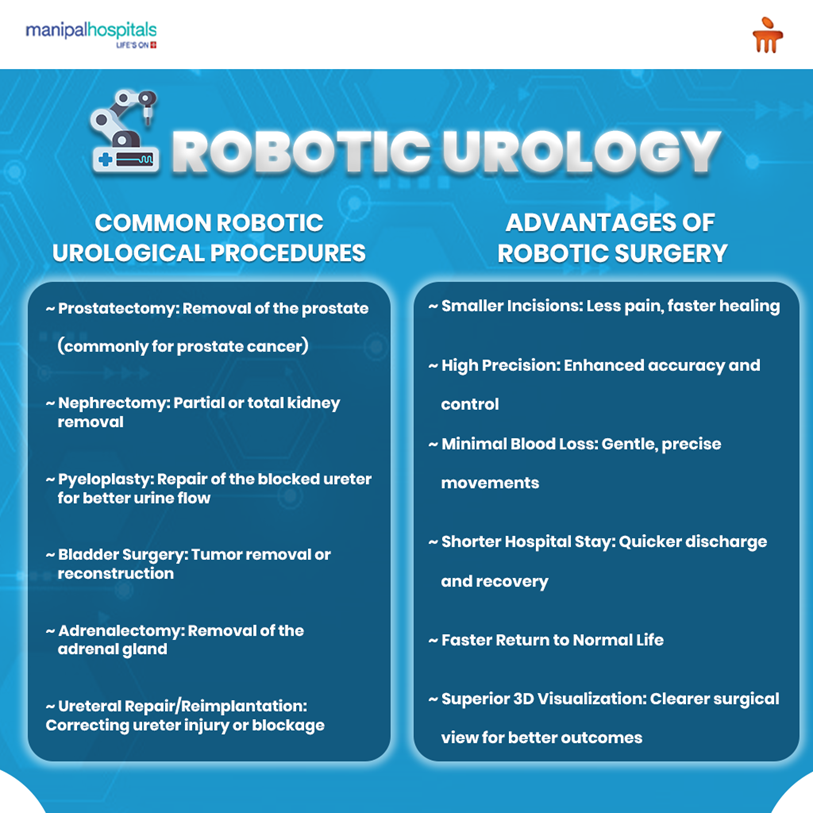
1. Prostatectomy
In robotic prostatectomy, the prostate gland is removed, often to treat prostate cancer. The robotic system allows the surgeon to see and work with great accuracy. This helps protect the nearby nerves that control bladder and sexual function, leading to faster recovery and fewer side effects after surgery.
2. Nephrectomy
A robotic nephrectomy is done when part or all of a kidney needs to be removed due to a tumour or severe damage. The robotic instruments help the surgeon work through small cuts, control bleeding better, and save as much healthy kidney tissue as possible.
3. Pyeloplasty
In robotic pyeloplasty, the blocked part of the ureter where it joins the kidney is repaired. This helps urine flow normally again. The robotic system provides a clear, enlarged view, helping the doctor stitch delicate tissues smoothly and safely without causing strain.
4. Robotic Bladder Surgery
Robotic bladder surgery is used to remove tumours or rebuild parts of the bladder. With the help of smaller cuts and more control, patients experience less pain, minimal blood loss, and faster healing compared to traditional open surgery.
5. Adrenalectomy
In robotic adrenalectomy, one or both adrenal glands are removed. The robotic arms help the surgeon reach these small glands easily while avoiding nearby organs and blood vessels. It allows more careful work with less disturbance to the surrounding tissues.
6. Ureteral Reimplantation or Repair
Robotic ureteral repair is done to resolve blockages or injuries in the ureter, the tube that carries urine from the kidney to the bladder. The robotic tools help the surgeon perform this delicate procedure with steady movements, improving urine flow and healing outcomes.
Why Patients Choose Robotic Surgery
Many patients today prefer robotic urology surgery because it is highly effective and enables them to get back to normal soon. The small cuts, clear vision for the surgeon, and gentle handling of tissues make a big difference in how recovery feels after surgery. Most people notice less pain, fewer scars, and faster healing.
Here’s why it helps:
-
Smaller cuts mean less pain and very little scarring.
-
The high precision allows safe work around delicate areas like the prostate and ureter.
-
Blood loss during surgery is much lower.
-
Recovery is quicker, and most patients can go home sooner.
-
The 3D camera gives surgeons a clear, enlarged view, improving accuracy and safety.
FAQ's
Prostate health becomes more relevant as men age; this includes the age group of 50 and over. Men with a family history of prostate problems also are at a higher risk.
In cases with normal age-related changes in urination, there is a gradual decline in urine stream strength, whereas BPH symptoms include much more persistent and worsening symptoms like increased frequency, urgency, or difficulty in initiating urination are a few indicators of BPH.
test
Sexually active persons aged between 21 and 65 should go for a Pap smear once every 3 years. In the case of HPV DNA co-testing, the screening may be required once every 5 years. Your doctor will suggest the right intervals, depending on your health.
Yes, you need to avoid the below-mentioned factors before the test:
Sexual activity
Vaginal douching
Using vaginal medicines
Otherwise, the reports may not be accurate.
Colposcopy is usually not a painful procedure. However, you may feel a mild discomfort. There might be a brief stinging sensation, too.
Share this article on: